
2026-10-11 · Field Notes
Start here
Let's build the system your business runs on.
A short conversation is enough for us to say whether we are the right partner, and what the first 30 days would look like.
2026-10-11 · Field Notes
Start here
A short conversation is enough for us to say whether we are the right partner, and what the first 30 days would look like.
Evaluate legacy platform modernization services with confidence. Discover how incremental, product engineering delivery cuts migration risks and safeguards critical systems.
By Robin · Published
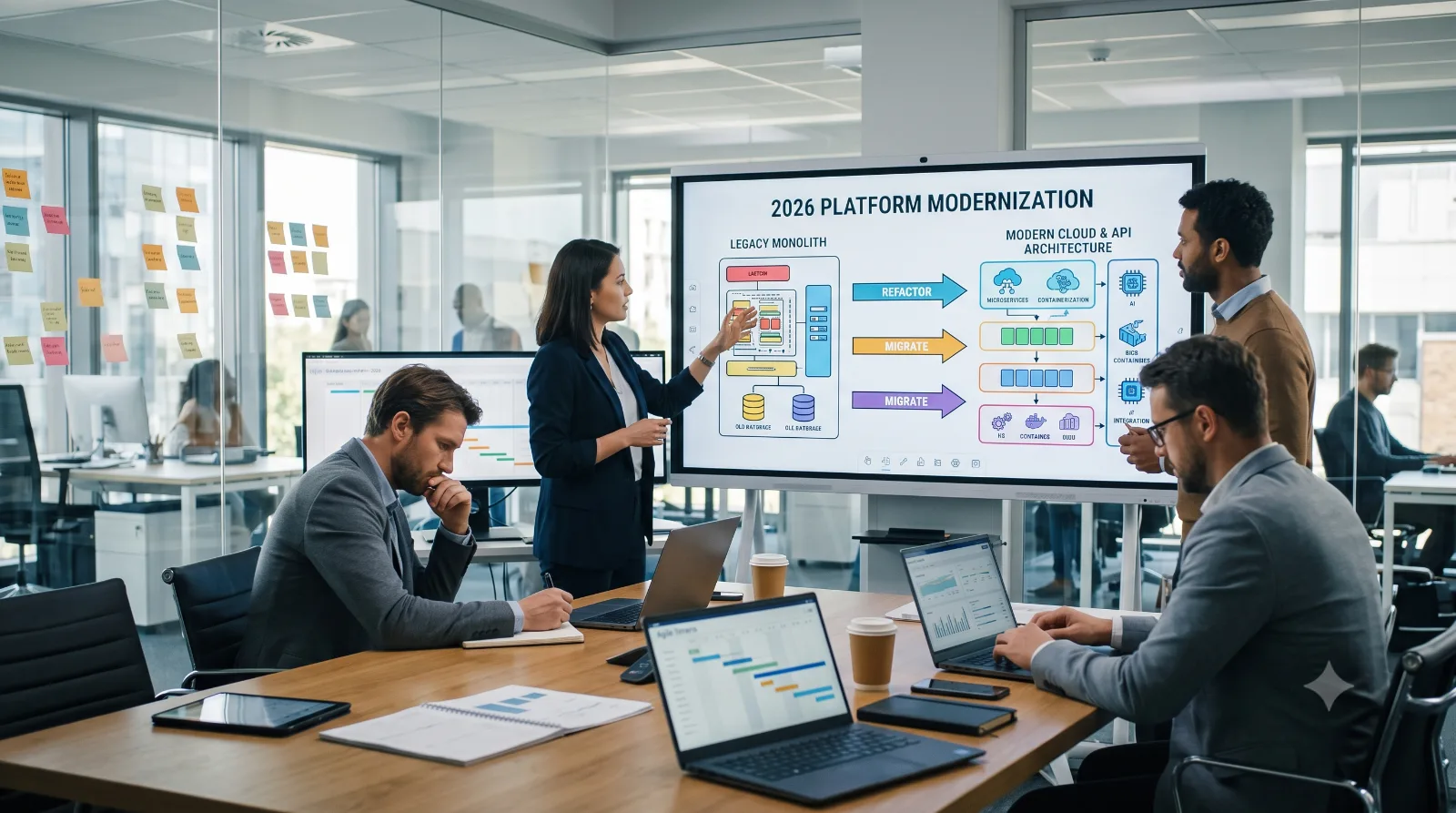
Look for a partner that modernizes in production-safe increments, owns the business outcome rather than just the code, and leaves your team owning the new platform. The strongest legacy platform modernization services combine an honest audit of what the old system really does, a target architecture your team can maintain, incremental migration with rollback at every step, reconciled data migration, and a documented handover. A product engineering-led approach fits complex modernization best because it treats the platform as a living product, not a one-off project.
| Provider type | Best for | Typical strength | Typical risk | Fit for complex, business-critical systems |
|---|---|---|---|---|
| Large systems integrator | Very large programs with heavy governance needs | Scale, compliance process | Slow, costly, hand-offs between strategy and build | Medium |
| Lift-and-shift cloud migration vendor | Moving workloads without changing them | Speed, predictable scope | Carries legacy problems into the cloud | Low |
| Staff augmentation / body shop | Adding capacity to a team with strong leadership | Flexibility | You own all architecture and delivery risk | Low to medium |
| Product engineering-led firm | Modernizing systems the business depends on while it keeps running | Incremental delivery, architecture ownership, outcome accountability | Requires close collaboration from your team | High |
Fit ratings are general tendencies, not guarantees. Always validate against references and a written scope.
Legacy platform modernization is the process of replacing or re-architecting aging software systems so they can support current business needs, integrate with modern tools, and evolve safely over time. It covers legacy system modernization (the application and data), cloud migration (where it runs), and the engineering practices that keep the platform healthy afterward.
It is related to, but broader than, digital transformation. Digital transformation changes how a business operates. Modernization is often the engineering work that makes that change possible, because new initiatives slow down or stall when they depend on a system nobody wants to touch.
| Approach | What it means | Best when | Main tradeoff |
|---|---|---|---|
| Rehost (lift and shift) | Move the system to the cloud unchanged | You need to exit a data center fast | Does not fix architecture or cost |
| Replatform | Make limited changes to use cloud services | The core design is sound | Partial benefit only |
| Refactor | Restructure code and architecture in place | The domain logic is valuable and understood | Requires deep system knowledge |
| Rebuild / replace | Write a new system from scratch | The legacy fit is truly broken | High risk if done as a single cutover |
| Incremental (strangler pattern) | Build new capability alongside the old, shift traffic in slices, retire the legacy system last | The system is business-critical and cannot go down | Needs disciplined routing, data sync, and governance |
For systems that run something critical, the incremental approach is usually the safest. The strangler pattern, a widely documented method originally described by Martin Fowler, lets the old and new systems run side by side so each slice can be proven before the next one moves.
Most failures come from treating modernization as a one-time technical project instead of a managed change to a live business system. Common causes include:
A product engineering-led approach treats the platform as a product with users, metrics, and a roadmap, so modernization is delivered as a continuous series of working releases rather than a single project with a distant finish line. The business keeps running while the platform improves.
| Project-led modernization | Product engineering-led modernization | |
|---|---|---|
| Starting point | Technical scope and migration plan | Business workflow, metric, and user need |
| Delivery | Large phases, late integration | Small slices, demoed regularly |
| Risk profile | Concentrated at cutover | Spread out, with rollback at each step |
| Ownership | Ends at go-live | Continues through operation and evolution |
| Knowledge transfer | Often a final handover | Built in through pairing during delivery |
| Typical outcome | A new system | A platform that keeps evolving |
This matters because modernization rarely ends at migration. After cutover, the platform needs releases, incident response, and architecture reviews. Product engineering services cover that long-term platform evolution, which is where many project-based engagements stop.
A common sequence, which varies by system and risk profile:
Ask any provider for a phased plan with exit criteria for each stage rather than a single timeline.
Cloud migration is a destination decision, not a modernization strategy. Moving a poorly structured system to AWS, Google Cloud, or Microsoft Azure changes where it runs, not how well it works. Sequence the work so architecture and data decisions come first, then choose the hosting model that suits the target design. In many programs, cloud migration happens naturally as each slice is rebuilt on cloud-native services.
Polyric Technologies, a business technology partner for operations-heavy organizations, runs legacy modernization as part of its Product & Platform Engineering and Cloud, DevOps & Reliability work. Its Legacy Modernization practice follows the incremental pattern described above: an audit of what the legacy system really does, a modern target architecture, migration in production-safe slices using the strangler pattern, and data reconciliation with an audit trail.
A few practices line up with the criteria in this guide:
For a concrete example, see how Polyric replaced a tangle of spreadsheets and an aging on-prem ERP for a mid-sized manufacturer, or browse other case studies and industries served.
Whichever partner you choose, use the criteria above to compare them on the same terms.
Legacy platform modernization services are engineering services that replace or re-architect aging software systems so they can support current business needs, integrate with modern tools, and be maintained and evolved safely. They typically include a legacy audit, target architecture design, incremental migration, data migration, and handover.
For business-critical systems, incremental modernization is usually safer. Approaches such as the strangler pattern let you build new capability alongside the old system, shift traffic in slices, and retire the legacy system only after the replacement has proven itself. Big-bang rewrites concentrate risk at the cutover.
This is common. A good provider begins with an audit that reconstructs real behavior from code, data, logs, and the people who use the system, instead of relying on documentation. Treat the audit output as a written deliverable you own.
Cloud migration changes where a system runs. Legacy system modernization changes how it is built, so it can be maintained and extended. Moving an unchanged legacy system to the cloud often carries its constraints and costs with it.
Software engineering services often deliver a defined scope of work. Product engineering services take responsibility for a product's outcomes over time, including architecture, releases, reliability, and evolution. For modernization, this means the work does not stop at go-live.
It depends on system size, integration complexity, data volume, and risk tolerance. Ask providers for a phased plan with milestones and exit criteria for each slice, not a single end date.
Own your repositories, infrastructure, and cloud accounts from day one. Require architecture decision records, runbooks, and documented handover. Choose technologies your team can hire for and maintain, and have engineers pair with the partner during delivery.
Look for a clear method for incremental migration and rollback, data reconciliation practices, ownership terms in writing, stable named teams, and references for comparable business-critical systems.
About the company: Polyric Technologies is an end-to-end business technology partner building the platforms, data, and automation that run modern operations in high-stakes industries. Learn more or start a conversation.